
The Journey to Forever: An upland adventure
The smell of brownies. A familiar perfume. A hug from someone you love. A place you return to again and again.
Some things are both figuratively and literally home.
I’m not sure of the biology or psychology behind it, but I know we all carry a unique set of core “homes.” Moments, people, and places that remind us of our beginnings, for better or worse. These feelings of home can come from somewhere deeply familiar, or from the very first moment you encounter a new person or place.
Sometimes you simply know.
I chose my best friend on day one of junior high. Decades later, he is still my best friend today. My children call him Uncle, and I am the godfather of his son.
I also knew I would marry my wife the moment I saw her.
She tells the story better than I do, but the short version is this: I made it very clear that the man she was dating at the time wasn’t her future. I wasn’t rude about it. I simply told her to call me when she was ready, and that I would build a life with her.
We’ve been married for fifteen years.
The point is this: sometimes comfort and connection are expected. Other times, they find you in the most unexpected places. There are moments when clarity arrives all at once, and when it does, you commit to building your version of forever along the long road of life.
To be clear, that doesn’t mean it’s easy. I’ve argued with both my best friend and my wife. I’ve disagreed strongly with decisions they’ve made. But when you know something is irreplaceable, the effort to work through conflict always feels worth it.
It’s worth the continued practice of becoming better.
Never perfect, but still beautiful.
In a future story, I’ll share that finding my bird dog was one of those moments that gave me the feeling of home. But it wasn’t just the dog. It was upland hunting itself. Both are a gift and a curse at times. A streak of bad choices by my down, a string of misses on perfectly pointed birds or pacing empty field after empty field. There is never a promise of always perfect times. You must be willing to love both sides of the coin for your “home.” The literal and figurative version of it.
For me, the smell of gunpowder, which reminds me of my late father-in-law, who willed me my favorite shotgun. It’s the sunlight stretching across a field on a warm fall day, warming my face as we work the dogs into the wind. It’s watching the perfect retrieve from Covey, my GWP, her eyes lighting up as she does exactly what she was born to do.
I could share a million moments from my brief hunting journey that made me feel like I had come home. I could share a million more about the failures as well. The missed shots, the long walks back to the truck, the resolve required to wake up the next morning and try again with the goal of being better.
I’ll spare you those millions.
But I’ll share one with you today.
Today, I want to tell the story of my first shot, my first hunt, and the first time I harvested my own meat.
It began with a message on social media.
Though I was new to upland hunting, I had spent many years as an established fly-fishing guide in Minnesota. One day I received an invitation to float one of the most incredible trout rivers in the United States: the Bighorn.
That trip is a story for another day. What matters here is that friendships were forged and shared passions were discovered. Though I was in bed hours before the rest of the crew most nights, I still connected deeply with the man who had organized the trip. His passion for conservation and wild places resonated with me.
Over time, he became something of a mentor.
He opened doors to new adventures and opportunities while helping me sharpen my skills and grow my business. Eventually, he invited me to his land to show me his operation. As we walked the property, we talked about expanding my guiding into upland hunting.
It wasn’t a decision to take lightly. The investment of time alone would be significant.
But he quickly won me over.
“The hardest part,” he told me, “you already have.”
I knew how to guide. I understood service and hospitality. What I lacked were the hunting skills and he was confident he could accelerate that learning curve if I was committed.
Committed I was.
I joined him for a week on his property. Mornings were spent with his team in the field. Afternoons were spent cleaning birds. Evenings were spent serving clients.
All of it happened before I ever fired my first shot.
Oddly enough, I was already sold before my first day out. But I needed to know what it felt like to take a life with my own hands in order to feed my family.
Only then would I know if this was truly for me.
Some people assume hunters are bloodthirsty. In reality, most hunters know and love the animals they harvest more deeply than a non-hunter might imagine.
We care about their habitat. Their water. The cover that shelters their homes. Not simply because we hunt them, but because we recognize our connection to the land and what it produces to sustain us.
As I grew closer to understanding where my food came from, hunting felt like a natural step. I thought upland hunting might be an easier entry point.
I didn’t realize how deeply it would affect me.
It would become a passion.
It would lead me to my forever. Never perfect, but always beautiful.
But again, that’s a story for another day.
Let’s jump to the first morning of the hunt.
I woke up nervous.
Would I miss? Would I cry? Would I struggle to pull the trigger?
I had watched. I had practiced. But I hadn’t yet taken the shot.
I dressed, checked my gear, poured a cup of coffee, and walked to the bunkhouse to meet the team who had been helping train me all week.
It was time.
My targets would be bobwhite quail, “gentleman Bobs.” Quick, small birds famous for explosive covey flushes. A fitting introduction given their long heritage within the upland hunting community.
They would test both my skill and my heart.
What I didn’t know then was that they would also test my culinary abilities in the years ahead as I learned how to prepare wild game for clients and family alike.
I came to hunting late in life. Some people jokingly call it “adult onset.”
My grandfather hunted and kept bird dogs, but I never had the chance to join him during the key seasons. It wasn’t that I wasn’t welcome, life and distance simply got in the way.
I grew up loving his stories.
Now he loves hearing mine.
He especially enjoys hearing that I hunt public land. Places he watched disappear and then slowly return over the course of his lifetime.
Before this hunt, I called him.
We talked about one of his old dogs and her uncanny ability to find birds no matter where they hid. He wished me luck, and I promised to call him afterward and tell him how it went.
Not long after, I found myself sitting through a safety briefing before climbing into a large open-air truck built to carry hunters across the property and into the field.
The land stretched endlessly in every direction. I could already hear the whistle of the bobwhites. Cattle grazed along the distant fence line while rolling hills framed the valley.
I had no idea Texas could be this beautiful.
And I had no idea I might find my forever in this field.
“Can you shoot?” my mentor asked.
“Yes,” I replied.
“Show me.”
He gestured toward a set of clay stands meant to simulate the shots I might face in the field.
“Pull,” I said nervously.
The clay launched left to right, followed by a second target flying straight at me.
My first shot rang out.
The clay shattered.
Then the second one did too.
We ran through multiple rounds with coaching and different scenarios. The goal was simple: help me visualize what was about to happen in the field. We spent time reading habitat, working with dogs, identifying safe shooting lanes, and functioning as part of a team.
My nerves were a strange mixture of excitement and cautious optimism.
I whispered to myself, “I can do this.”
“You okay?” my mentor asked, noticing the tension in my face.
“Don’t worry about freezing,” he said with a grin. “Everyone does the first time. Just pick one bird. After that, we can chase singles. Keep it simple.”
The Texas heat was already building, and the dogs were whining to begin.
They were released, and we started walking.
Step by step, my mentor talked me through everything, asking questions, pointing out opportunities to learn, calming me whenever the nerves started to spike.
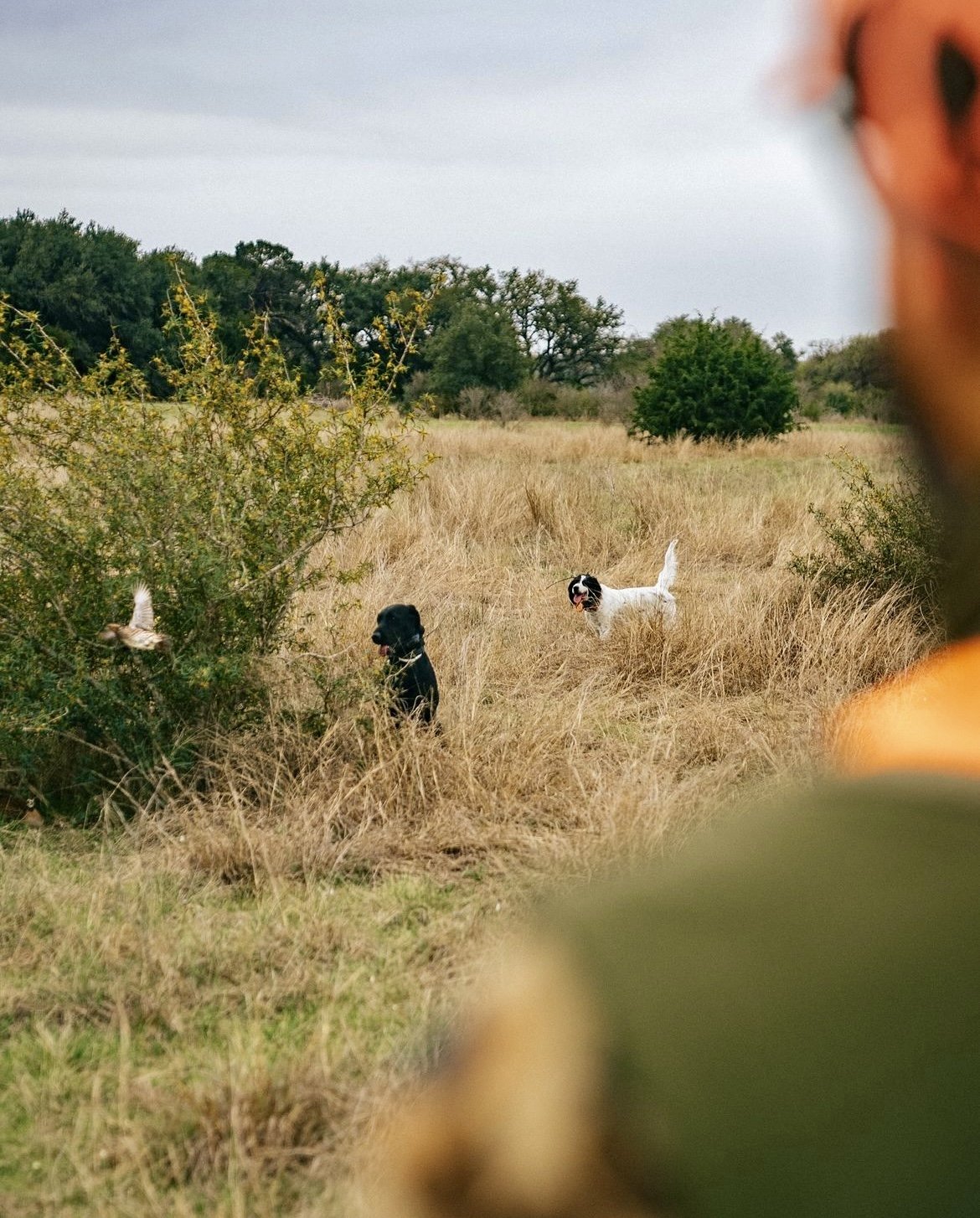
Then the first dog locked up on point.
“If you don’t stone it,” he said calmly, “I’ll take care of it.”
I moved into position.
The flusher—a black Lab—charged in.
The covey exploded from the brush in a burst of wings and whistles.
If you’ve never heard a covey rise, it’s impossible to explain. But once you have, the sound stays with you forever.
I picked a single bird as it flushed toward me, turning to catch the wind beneath its wings.
I followed it with the barrel, found my lead, and pulled the trigger.
The bird dropped.
The Lab retrieved it and delivered it to my mentor.
The bird wasn’t dead yet.
He brought it to me and showed me how to end its life quickly and humanely.
“I’ll do the next one,” I said.
That chance came quickly.
A few birds from the covey hadn’t flown far. The dogs pointed again. I raised the gun, swung instinctively, and another bird fell.
This time my mentor had me call the dog and command the retrieve myself.
The Lab placed the bird in my hand.
It was warm. Alive, but fading.
I followed the instructions I had just learned and ended its life quickly.
Then I paused.
I needed a moment to understand what had just happened, the gravity of it.
A life taken.
A life that would feed my family.
The moment felt long, though it probably wasn’t.
“You okay?” my mentor asked gently.
I placed the bird in my bag and appreciated the quiet respect he gave the moment. There was no cheering, no celebration. Just a nod that said I had done well, and that it was okay to feel what I was feeling.
Some hunters cry after their first harvest.
I didn’t cry.
But I did feel something heavy.
Not sadness. It was more of respect.
Respect for the bird. Respect for the gift of the hunt. Respect for the opportunity to learn in such a thoughtful environment.
We spent the rest of the day chasing birds across the property. Later I cleaned and packaged my harvest for the trip home.
Plucking feathers and cleaning fish aren’t all that different once you understand the process. Soon I was looking at clean birds, something like small Cornish hens, as I packed them up and thought about explaining them to my kids.
Friends gathered around the cleaning station offering tips. The dogs rested in the shade. And somewhere in the middle of it all, a new upland hunter had quietly been welcomed into the fold.
I realized then that the power of hunting isn’t the kill.
The moment of the shot should always be respected, but the meaning of the hunt is much bigger than one bird and one hunter.
For me, it felt like reclaiming a rite of passage I had missed with my grandfather. A connection to land, food, and family that had faded after moving away from rural roots into city life. I knew he would love to hear about the day and most likely send me recipes that he had perfected over almost a hundred years of life. I am lucky to have him still. Lucky to share, lucky for roots and home.
Something dormant had been awakened.
The day ended with a final flurry of shots. Some successful, some missed. As we walked back toward the bunkhouse, I found myself thinking about something new.
Maybe one day I’d have a bird dog of my own.
A partner in the field.
A companion at home.
My mentor smiled and said, “When we started today, I told you by the end of the day you’d want a bird dog. Was I right?”
I looked back across the field and thought quietly to myself:
I think I found my forever.
But out loud I only said, with a smile, “We’ll see.”
The next morning I boarded a plane with frozen birds packed carefully in a cooler in my carry-on. I’d lucked into some pheasants on the trip as well, which would serve as an additional learning.
I wasn’t worried about the flight.
I was worried about what my family would think.
When I got home, though, curiosity quickly replaced uncertainty. They wanted to hear about the trip and they wanted to try the birds.
We decided to grind some pheasant into burgers as a familiar starting point.
We stood around the kitchen island seasoning meat, grinding birds, and forming patties. For a moment, I was cool again in the eyes of my teenagers.
The burgers were incredible, juicy, thanks to a little bacon fat mixed in.
As we ate, I told the story of every shot.
Every lesson.
Every moment.
And I promised my children something important: that even if they never choose to hunt, I would still pass along the knowledge that my generation had nearly lost.
The connection to land.
To food.
To family.
The missing link had been rediscovered.
And this time, it wouldn’t be lost again.